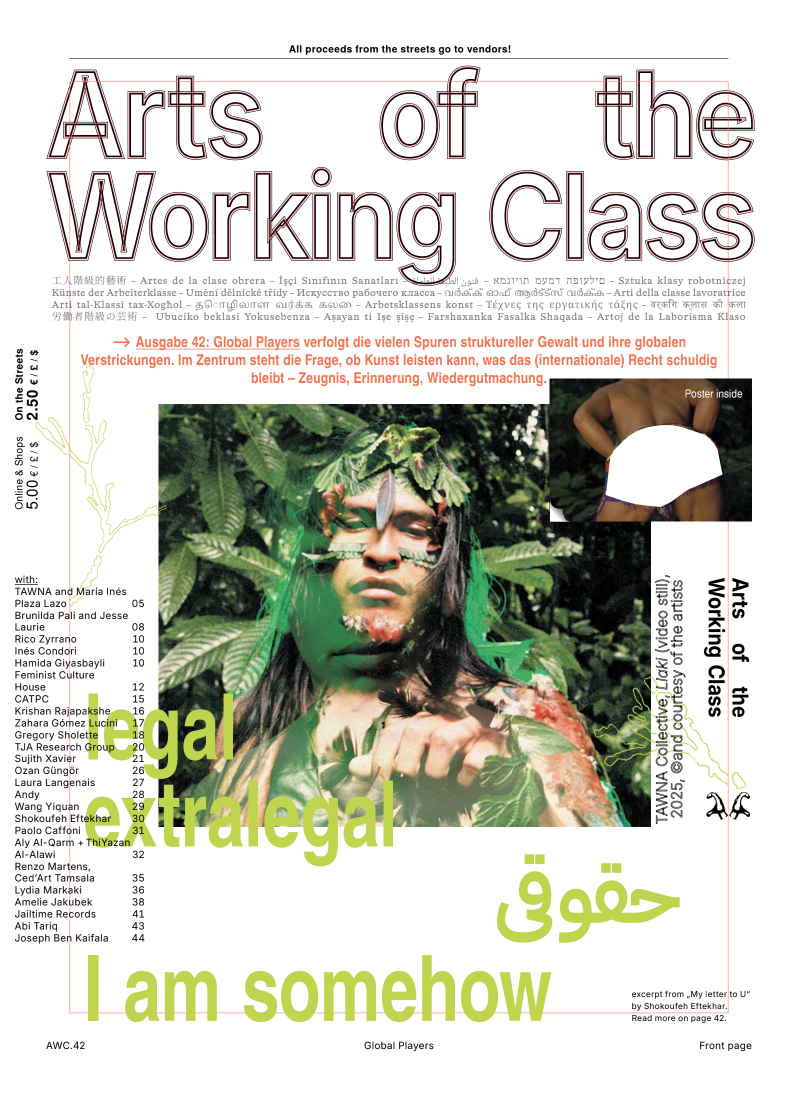

Arts of the working class
ISSUE 42: GLOBAL PLAYERS
ISSUE 42: GLOBAL PLAYERS
Couldn't load pickup availability
Across the world, by popular voice, an editorial has already been written, and this issue will propel it further: the collective chant of “No Justice, No Peace”, the shorter, punchier descendant of Martin Luther King's Vietnam War era analysis that peace as currently brokered can function as an instrument of power rather than a remedy for it. Alone, peace deals cannot put an end to genocides and wars—only the establishment of justice will. The slogan above expresses the awakening of a collective consciousness in the wake of International Law’s failure to hold accountable the full spectrum of actors (or indeed anyone) implicated in war crimes and colonial violence from Venezuela to Sudan to the Democratic Republic of Congo to Syria to Gaza.
If peace alone is inadequate, what about justice? Justice, yes, but when we use the term, what do we mean? Justice by and for whom? This issue, titled Global Players, is the result of a collaboration with AFIELD (Paris) and Framer Framed (Amsterdam), and begins with this question. Dedicated to Transitional Justice, it puts the universality of justice on trial, illuminating the shifting spatio-temporal conditions in which it is negotiated.
The origins of Transitional Justice emerge from efforts to confront widespread human rights violations in nations moving from conflict, authoritarian rule, and repression toward peace, democracy, and stability. The aftermath of World War II, particularly the Nuremberg Trials, where Nazi leaders were tried for war crimes, crimes against humanity, and genocide, established a standard for how the international community responds to severe human rights violations, with a focus on accountability, truth-seeking, and compensation. Since then, many nations have sought their own ways of addressing histories of violence and reconstructing their societies: South Africa’s Truth and Reconciliation Commission after apartheid, Latin America's transitions from military dictatorship through the 1980s and 90s, and the reckonings in the Balkans after the Yugoslav wars. However, the consequences of enduring violence do not move linearly; they travel in vortical loops of trauma.
Following Transitional Justice’s four pillars: the right to know; the right to justice; the right to reparation; and the right to non-repetition, Global Players’ pages engage with what it means to speak of justice when historical violence continues to structure the present in the inseparable conditions of our shared global reality. The false dichotomy of “here” and “there” is exacerbated by an International Law written overwhelmingly in the Global North, where law and art are subjugated to (and collusive with) neoliberal elitism, and where cultural practice carries almost no weight in the formal processes through which justice is rebuilt after conflict.
This issue probes the contrary: that an art, less exclusive, more porous, capable of holding contradictions that legal language cannot, might do real work precisely by bearing witness, by restoring the texture of memory, by making legible what tribunals leave unnamed: the distance between legal principle and lived experience. Global Players then reaches toward that conjunction and extends the invitation visually through a collaboration with Tawna, an Amazonian film collective whose practice approaches moving image as testimony, situated storytelling, and sustained attention to contested geographies of experience, currently presented at the first Ecuadorian Pavilion of the 61st Venice Biennale.
War and violence, like colonization, take more than rights and land. They strip away the cultural rituals through which people grieve, celebrate, and remember. In Supply Lines, our chapter dedicated to first-hand experience from workers, the conflict facilitator Hamida Giyasbayli reflects on how political exile reshapes the language available to describe in-between states of being. Inés Condori testifies on the looting of dignity suffered by women subjected to forced sterilization in Peru. With these losses go the threads that bind people to one another and to the places they call home, wounds that run in many directions, and that call both for systemic change and for the particular work that artists can do.
Moving ahead, the issue widens its lens. Command Centers features a conversation with Gregory Scholette about the intersection of justice and socially engaged art, alongside a critical perspective from the Third World Approaches to International Law (TWAIL) scholar and lawyer Sujith Xavier on the limits of Transitional Justice as a framework. Reverberations turn to subtler, structural forms of harm, including algorithmic governance, urban precarity, and the politics of green space, focusing on work by Wang Yiquan and Laura Langenais. Tactics makes legible the strategies of artists operating in conflict zones and carceral conditions through pieces by Aly Abdallah, ThiYazan Al-Alawi, and Jailtime Records. Side Games closes the issue with Joseph Kaifala’s Interactive Life Path, a meditation on the choices that introspectively, but insistently, determine a life. Finally, we circle back to the cover, where the artist Shokoufeh Eftekhar questions, in poetry, what it means to be determined by the law. Their answer is: I am somehow.
This issue brings together an extensive international group of artists, writers, researchers, and practitioners: ThiYazan Al-Alawi, Aly Al-Qarm, Paolo Caffoni, CATPC, Inés Condori, Shokoufeh Eftekhar, Feminist Culture House, Hamida Giyasbayli, Zahara Gómez Lucini, Ozan Güngör, Jailtime Records, Amelie Jakubek, Joseph Ben Kaifala, Laura Langenais, Jesse Laurie, Andy Liu, Lydia Markaki, Renzo Martens, Brunilda Pali, María Inés Plaza Lazo, Krishan Rajapakshe, Gregory Sholette, Ced'Art Tamsala, Abi Tariq, TAWNA, TJA Research Group, Wang Yiquan, Sujith Xavier, and Rico Zyrrano.
Imprint
Founder / Publisher / Editor at Large
María Inés Plaza Lazo
Editor in Chief
Dalia Maini
Associate Editors
The research group of the Transitional Justice with Artists project (Amelie Jakubek, Abi Tariq, Chantal Wong, Lydia Markaki)
Copyediting
William Kherbek, ezo karamell
Distribution and Administration
Laurentiu Dragota
Layout, Design
Manuel Burger
This issue is co-funded by the European Union, in partnership with AFIELD and Framer Framed.